Why the next era of accounting belongs to systems, not tools
You've invested in the tools, but the firms gaining ground have moved on to something else entirely.

Andreas Meisingseth
Co-founder & CPTO
The accounting profession is at an inflection point. Not because AI has arrived (it has been arriving for years) but because the firms that understand what to do with it are about to pull away from the ones that are still figuring it out.
The model race is over. The systems race has begun.
For the last three years, the technology conversation has been dominated by models. That conversation is now being replaced by a more consequential one. IBM's chief AI architect put it plainly heading into 2026: we are approaching a commodity point, and competition will shift from models to systems. Gartner forecasts that enterprise applications with AI agents will grow from 5% to 40% by end of 2026, but the same organisation warns that over 40% of those projects will be cancelled by 2027, because isolated intelligence deployed across fragmented tooling does not produce the coordinated outcomes firms actually need. We believe the cost of intelligence will approach zero, making intelligence widely available as a commodity.
However, access to AI and the ability to operationalise it are not the same thing. The gap between them is where most accounting firms currently sit - and where most will stay unless something changes in how they think about the problem.
The problem nobody has named clearly enough
A senior accountant at a large practice carries something that does not appear on any balance sheet: years of accumulated client knowledge. It is one of the most valuable things a firm possesses, and by necessity, almost entirely personal.
That personal dependency is where the challenge begins. An enormous amount of capacity gets consumed by the data wrangling that underpins every client engagement (the bookkeeping, the reconciling, the chasing, the scheduling) before anything reaches the people who can act on it. And when it does, those same partners and senior managers are the ones whose judgment and approval are required to move it forward. The close becomes a bottleneck not because of any failure of capability, but because the knowledge required to resolve it is concentrated at the top.
Many firms are actively trying to address this, running AI pilots across document processing, bookkeeping automation and workflow tooling. The intent is right, but isolated intelligence across disconnected tools does not resolve a coordination problem, it simply adds to it. That’s because the bottleneck has never been a single task, but rather the absence of a system that coordinates across all of them.
Why a system of work is a different category entirely
Most technology accounting firms run today falls into one of two categories: systems of record, which store and organise information, and point solutions, which automate specific tasks. Both have their place, but neither coordinates across the full workflow, nor accumulates the client-specific, firm-specific institutional knowledge that makes the difference between a tool that works in a demo and one that changes how a firm operates. And in a large firm, where every new technology must navigate compliance review, IT governance and rollout across multiple offices, each additional point solution adds friction rather than removing it.
What has been missing is a system of work; a layer that sits above the system of record and coordinates everything that happens around it. One that knows how your firm works, builds institutional memory belonging to the firm rather than to any individual within it, and gets smarter with every passing month.
This is the category Mimo is building, and the architectural decisions that follow from it are not incidental. They are the reason it works where point solutions have not.
Non-disruptive by design, layering onto the tools and processes firms already use, requiring no rip-and-replace.
Human-in-control throughout, because in a regulated profession, nothing should affect the ledger without explicit approval.
And self-learning, because the value of a system of work compounds over time as it accumulates the context that currently exists nowhere but in people's heads.
Orchestration in practice with Mimo Associate
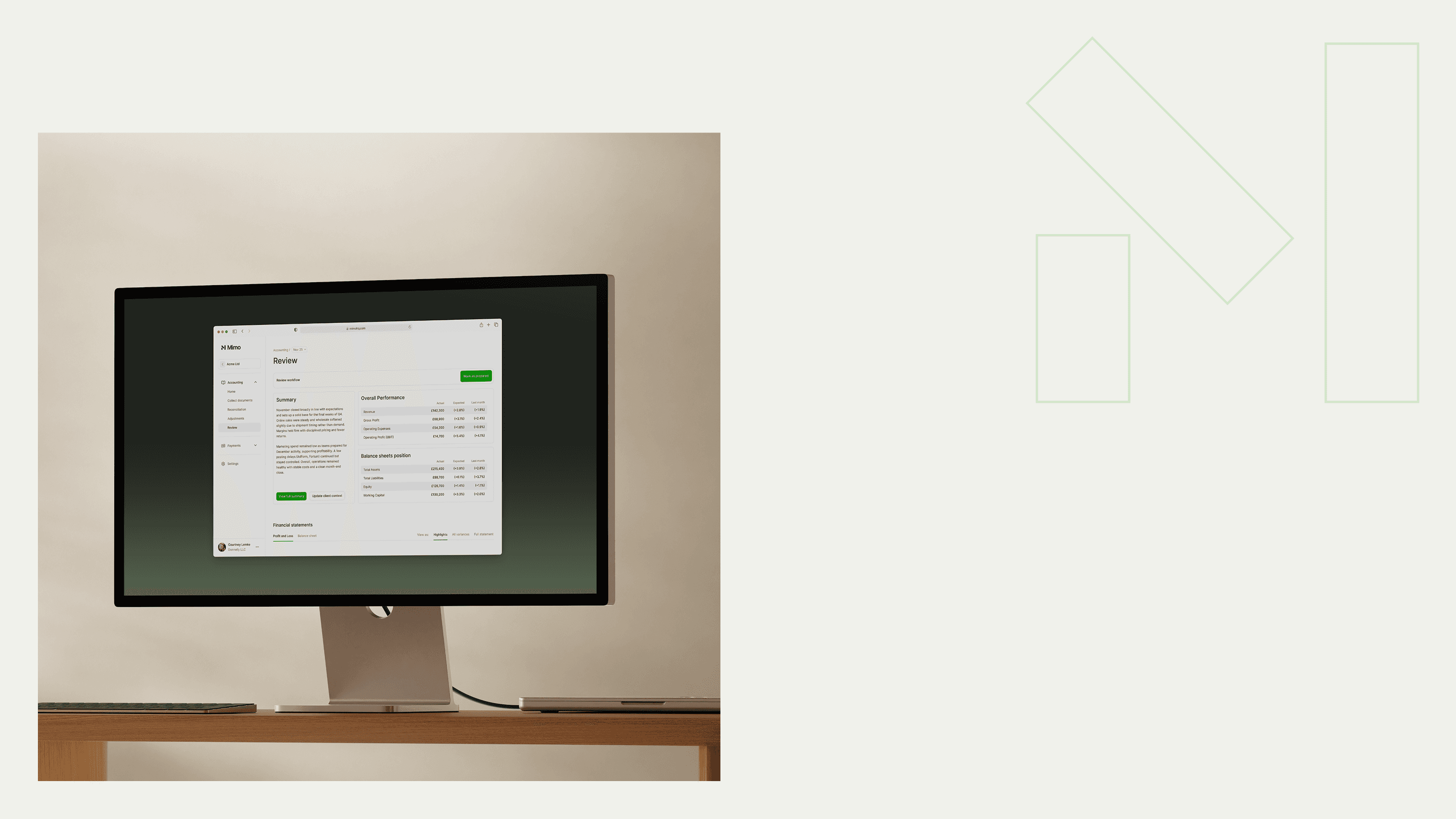
Mimo Associate is a full expression of this architecture operating in real firms. It runs month-end end-to-end - chasing documents, managing prepayment schedules, posting adjustments, coordinating exceptions for review - within a single system rather than across a chain of disconnected tools. It works throughout the month, not only at the close, shifting the nature of the work from last-minute pressure to ongoing, confident review.
The significance is not the individual tasks it handles, but what it demonstrates: that a system of work for accountancy is not a theoretical proposition.
Today, it exists. And the firms running it are getting back the capacity that the coordination problem has been consuming for years.
The compounding advantage of moving now
Month-end is the starting point. As the system accumulates context about the firm, its clients, and the recurring patterns, its ability to orchestrate expands. The institutional memory it builds belongs to the firm, not to individuals, and becomes more precise and more valuable over time.
The window to build that advantage is open now. The firms that move early will have accumulated months of institutional memory, refined workflows and compounding efficiency by the time the rest of the market reaches the same conclusion. The question is not whether a system of work becomes the operating infrastructure of every serious accounting practice. It is which firms are already running on one when that moment arrives.
Mimo Associate is available now. If your firm is ready to ask what comes next, we'd like to show you what that looks like in practice.